
BMI Calculator
Calculate your Body Mass Index and understand your weight category.
Your BMI Result
Enter your height and weight, then click Calculate BMI to see your results here.
BMI is a screening tool, not a diagnosis. It does not directly measure body fat or overall health.
What Is BMI (Body Mass Index)?
Body Mass Index (BMI) is a widely used measurement that compares a person’s weight with their height. It helps identify weight categories that may be associated with certain health risks. Healthcare professionals commonly use BMI as an initial screening tool because it is simple, inexpensive, and easy to calculate.
Our free BMI calculator helps you estimate your Body Mass Index using your height and weight. It provides an instant BMI score, a corresponding adult weight category, and a general BMI-based healthy weight range. These results can help you understand your measurements and decide whether further assessment or lifestyle changes may be useful.
However, results from a BMI calculator are not a direct measurement of body fat or a complete evaluation of health. People with similar BMI values can have different amounts of muscle, body fat, and abdominal fat. Age, ethnicity, medical history, and metabolic health can also affect how BMI should be interpreted.
Why Understanding Your BMI Matters
BMI provides a practical starting point for understanding weight in relation to height. It can help identify patterns that may deserve additional attention, particularly when combined with other information about your health.
For example, a person may have a BMI within the standard healthy range but still have increased abdominal fat or elevated blood pressure. Another person may have a higher BMI because of greater muscle mass rather than excess body fat.
This is why a BMI calculator should be used as a screening resource rather than a diagnostic tool.
Understanding your BMI alongside factors such as waist circumference, physical activity, blood pressure, and blood glucose can help you make more informed health decisions.

How to Use This BMI Calculator
Using our BMI calculator is straightforward. You only need your height and current body weight.
Follow these steps:
- Choose Your Measurement Units: Select Metric (centimeters and kilograms) or Imperial (feet, inches, and pounds), depending on which system you prefer.
- Enter Your Height: Use the height slider to enter your measurement. For better accuracy, measure your height while standing straight without shoes.
- Enter Your Weight: Adjust the weight slider using your current measurement. A reliable weighing scale and consistent weighing conditions can help improve accuracy.
- Click Calculate BMI: The calculator instantly displays your BMI score, standard weight category, and estimated healthy weight range.
How to Read Your BMI Results
Your result is a number that represents your weight relative to the square of your height.
For example, a BMI calculator result of 22.5 falls within the standard healthy adult range, while a BMI of 27.0 falls within the standard overweight category.
These categories describe statistical relationships between weight and health risk across populations. They do not determine whether an individual is healthy or unhealthy.
Important: This calculator is intended for general adult screening. Children and teenagers require age- and sex-specific BMI interpretation. Pregnancy also requires a different approach to weight assessment.
BMI Formula: How Is Body Mass Index Calculated?
The BMI formula uses weight and height to produce a standardized value expressed in kilograms per square meter (kg/m²).
You can calculate BMI using either metric or imperial measurements.
Metric BMI Formula
BMI = Weight (kg) ÷ Height (m)²
To calculate BMI manually, convert your height into meters, multiply it by itself, and divide your weight by that result.
Example: A person weighing 65 kg with a height of 170 cm
Height in meters = 1.70 m
Height squared = 1.70 × 1.70 = 2.89
BMI = 65 ÷ 2.89
BMI = 22.5
Under standard adult BMI categories, this result falls within the healthy weight range.
Imperial BMI Formula
BMI = 703 × Weight (lb) ÷ Height (in)²
Example: A person weighing 150 lb with a height of 5 ft 7 in
Height = 67 inches
BMI = (703 × 150) ÷ (67 × 67)
BMI = 105,450 ÷ 4,489
BMI = 23.5
This result also falls within the standard healthy adult BMI range.
Why Does BMI Use Height Squared?
The BMI formula divides weight by height squared to account for differences in body size. It offers a standardized way to compare weight relative to height.
However, this mathematical adjustment does not fully account for individual differences in body composition. BMI cannot tell whether a person’s weight comes mainly from muscle, fat, bone, or other tissues.
Our BMI calculator performs these calculations automatically, reducing the need to convert measurements or calculate the formula manually.
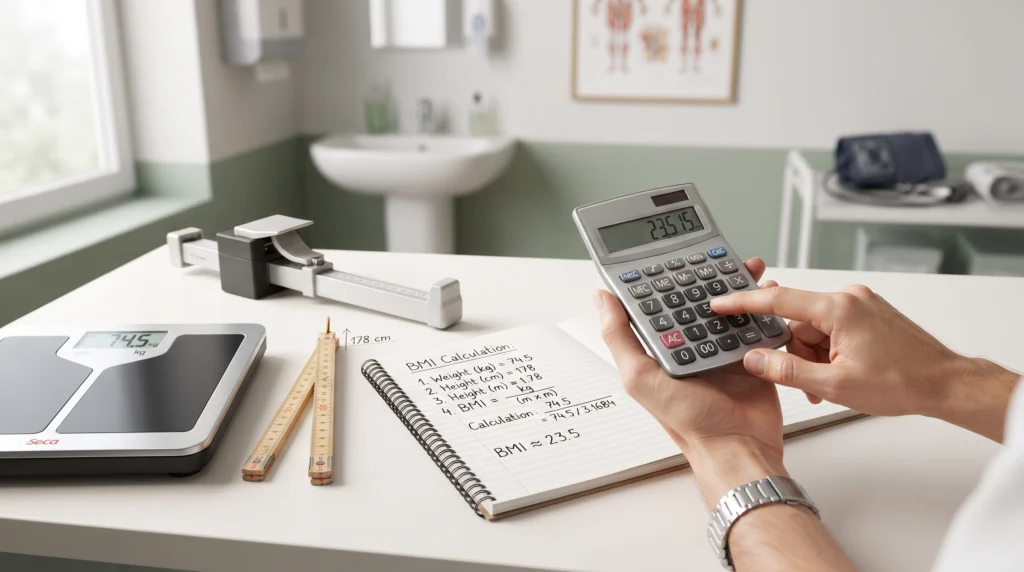
BMI Categories for Adults
The standard adult BMI classification divides results into four main categories: underweight, healthy weight, overweight, and obesity. Our BMI calculator helps you identify which category your result falls into.
Obesity is further divided into three classes to distinguish different ranges of BMI.
|
BMI Range |
Category |
|
Below 18.5 |
Underweight |
|
18.5 to below 25 |
Healthy weight |
|
25.0 to below 30 |
Overweight |
|
30.0 to below 35 |
Obesity Class 1 |
|
35.0 to below 40 |
Obesity Class 2 |
|
40.0 and above |
Obesity Class 3 |
These are standard adult screening categories. A person’s actual health risk depends on more than BMI alone.
For example, someone in the overweight category may have favorable blood pressure, blood sugar, and other health measurements. Conversely, someone within the healthy BMI range may have risk factors that require medical attention.
The most useful approach is to interpret BMI together with other relevant health information, rather than treating the category as a diagnosis.
BMI Chart: Reference by Height and Weight
A BMI chart helps you quickly compare Body Mass Index (BMI) values across different height and weight combinations. Alongside our BMI calculator, this chart provides a simple visual reference for understanding your estimated BMI.
To use the chart, find your height in the first column and your weight in the top row. The value where they intersect shows your approximate BMI.
|
Height |
50 kg |
60 kg |
70 kg |
80 kg |
90 kg |
|
150 cm |
22.2 |
26.7 |
31.1 |
35.6 |
40.0 |
|
160 cm |
19.5 |
23.4 |
27.3 |
31.3 |
35.2 |
|
170 cm |
17.3 |
20.8 |
24.2 |
27.7 |
31.1 |
|
180 cm |
15.4 |
18.5 |
21.6 |
24.7 |
27.8 |
How to Interpret the BMI Chart
Consider someone who is 160 cm tall and weighs 70 kg. Their BMI is approximately 27.3, which falls within the standard overweight category.
Now consider someone who weighs the same 70 kg but is 180 cm tall. Their BMI is approximately 21.6, placing them within the standard healthy category.
These examples demonstrate why body weight alone does not provide enough information to interpret BMI.
For an individual calculation using your exact height and weight, use the BMI calculator rather than relying only on rounded chart values.
Note: BMI values are rounded to one decimal place. Standard adult categories are shown for general reference.
Healthy Weight Range for Your Height
The standard adult healthy BMI range is 18.5 to below 25. This range can be used to estimate a corresponding body weight interval for a particular height.
The calculation works by multiplying the BMI boundary values by height in meters squared.
BMI-based Weight = BMI × Height (m)²
For example, someone who is 170 cm tall has a BMI-based reference range of approximately 53.5 kg to 72.0 kg.
Healthy Weight Reference Table
|
Height |
Approximate BMI-Based Weight Range |
|
150 cm (4 ft 11 in) |
41.6–56.0 kg |
|
160 cm (5 ft 3 in) |
47.4–63.7 kg |
|
170 cm (5 ft 7 in) |
53.5–72.0 kg |
|
180 cm (5 ft 11 in) |
59.9–80.7 kg |
|
190 cm (6 ft 3 in) |
66.8–89.9 kg |
Does a Healthy BMI Mean an Ideal Weight?
A healthy BMI range provides a general reference for assessing body weight, but it does not represent an ideal weight for everyone. While a BMI calculator helps estimate whether your weight falls within the standard range, factors such as muscle mass, age, ethnicity, body composition, and medical conditions can affect how the results should be interpreted.
For example, a strength-trained athlete may have a BMI above the healthy range despite having relatively low body fat. Similarly, someone with a BMI within the healthy range may still carry excess abdominal fat or have other health concerns.
Use these weight ranges as a general guide rather than a personalized health assessment. For a better understanding of your overall health, consider your BMI calculator results alongside waist measurements, body composition, and other relevant health indicators.
If you want to understand your energy requirements for maintaining your current weight, our TDEE Calculator can help estimate your daily calorie expenditure.

BMI for South Asian Adults
BMI deserves particular attention in South Asian populations, including people from Pakistan, India, Bangladesh, Nepal, and Sri Lanka.
Research indicates that some South Asian populations experience increased risks of type 2 diabetes and cardiovascular disease at lower BMI levels than are typically associated with increased risk in some European-origin populations.
One reason is that body composition and abdominal fat distribution may differ between populations. At the same BMI, some South Asian adults may have a higher percentage of body fat or more fat concentrated around the abdomen.
This means a BMI value considered within the standard international healthy range does not necessarily indicate the same level of cardiometabolic risk for every individual. Therefore, when using a BMI calculator, South Asian adults should consider their results alongside waist measurements and other relevant health indicators.
South Asian BMI Thresholds and Health Risk
The United Kingdom’s National Institute for Health and Care Excellence (NICE) recommends lower BMI thresholds for assessing overweight and obesity in people from several ethnic backgrounds, including South Asian populations.
|
BMI |
NICE Classification for South Asian Adults |
|
Below 18.5 |
Underweight under standard adult classification |
|
18.5–22.9 |
Below the lower overweight threshold |
|
23.0–27.4 |
Overweight |
|
27.5 and above |
Obesity |
These lower thresholds reflect differences in population-level risk. They do not mean that everyone above a certain BMI has a medical condition.
When interpreting results from a BMI calculator, it is important to know that the World Health Organization’s expert consultation also recognized BMI values of 23 and 27.5 as additional public-health action points for Asian populations, while retaining international BMI categories for comparison.
Example: A South Asian adult with a BMI of 24.2 falls within the standard international healthy weight category. However, this BMI is within the overweight range under the NICE ethnicity-specific classification.
What Should South Asian Adults Check Alongside BMI?
A BMI calculator can help identify your weight-for-height category, but a more complete assessment may consider:
- Waist circumference and abdominal fat distribution
- Blood pressure
- Blood glucose or HbA1c, when clinically appropriate
- Cholesterol and other relevant blood tests
- Physical activity and dietary habits
- Family history of diabetes or cardiovascular disease
If you have a family history of diabetes, high blood pressure, or heart disease, discuss appropriate screening with a qualified healthcare professional.

BMI vs Other Health Measurements
BMI is valuable because it is convenient and widely understood. However, it becomes more informative when interpreted alongside other measurements.
|
Health Measurement |
What It Helps Assess |
|
BMI |
Weight relative to height |
|
Waist circumference |
Abdominal size and possible central fat accumulation |
|
Waist-to-height ratio |
Waist size relative to overall height |
|
Body fat percentage |
Estimated proportion of body weight made up of fat |
|
Blood pressure |
Pressure within the arteries |
|
Blood glucose and cholesterol tests |
Additional metabolic and cardiovascular risk indicators |
Waist-to-Height Ratio: Why It Matters
Waist-to-height ratio is a simple measurement that compares waist circumference with height.
Waist-to-Height Ratio = Waist Circumference ÷ Height
Both measurements must use the same units.
For example, a person who is 170 cm tall with a waist circumference of 80 cm has:
80 ÷ 170 = 0.47
A commonly recommended guideline is to keep waist circumference below half of your height, corresponding to a waist-to-height ratio below 0.5.
For a person measuring 170 cm in height, this means aiming for a waist circumference below approximately 85 cm.
NICE recommends considering waist-to-height ratio alongside results from a BMI calculator when assessing central adiposity in adults with a BMI below 35.
This is a useful screening measure, but it should not be interpreted as a complete medical diagnosis.

What Does Your BMI Result Mean?
Your BMI category provides a starting point for understanding weight-related health considerations. The appropriate next step depends on your health, age, body composition, and personal circumstances.
Underweight: BMI Below 18.5
A BMI below 18.5 falls within the standard underweight category.
A low result from a BMI calculator may reflect a naturally smaller body size. In other cases, a low BMI may be associated with inadequate nutrition, an underlying medical condition, or unintended weight loss.
If you have experienced unexplained weight loss, persistent fatigue, or other concerning symptoms, seek medical advice.
Your daily energy and protein requirements should be evaluated according to your individual needs. Our Protein Calculator can provide a general estimate of protein requirements, but it does not replace clinical nutrition advice.
Healthy Weight: BMI 18.5 to Below 25
A result within the healthy weight range on a BMI calculator is generally associated with lower average weight-related health risk under standard adult classifications.
Maintaining healthy habits remains important even when your BMI falls within this range.
Focus on varied nutrition, regular physical activity, adequate sleep, and appropriate preventive healthcare.
You can also use our Macro Calculator to explore how protein, carbohydrates, and fats may fit into your daily calorie needs.
Remember that population-specific BMI guidance may differ, particularly for South Asian adults.
Overweight: BMI 25 to Below 30
A result in the overweight category on a BMI calculator may be associated with an increased risk of certain weight-related conditions, although risk varies considerably between individuals.
Small, sustainable lifestyle adjustments may improve health indicators, particularly when excess abdominal fat or other risk factors are present.
For adults who would benefit from weight loss, even a modest reduction in body weight may help improve blood pressure, cholesterol, or blood glucose.
Our TDEE Calculator can help estimate daily calorie requirements as a starting point for nutrition planning.
Obesity: BMI 30 or Higher
Under standard adult classifications, BMI 30 or above falls within the obesity category.
Higher BMI results from a BMI calculator are associated, at the population level, with increased risks of conditions such as type 2 diabetes, high blood pressure, cardiovascular disease, sleep apnea, and certain joint problems.
However, BMI alone cannot diagnose these conditions or determine an individual’s complete health status.
A healthcare professional can evaluate relevant risk factors and recommend an appropriate management plan based on medical history, health needs, and individual preferences..

Limitations of BMI: What the Number Cannot Tell You
Although BMI is convenient, understanding its limitations is essential for interpreting results responsibly.
1. BMI Cannot Distinguish Muscle From Fat
A BMI calculator uses height and total body weight to estimate Body Mass Index (BMI). However, it does not distinguish between the weight of muscle, fat, bone, or other tissues.
This limitation can make BMI less informative for people with substantial muscle mass, including some athletes and strength trainers.
2. BMI Does Not Identify Fat Distribution
Two people may have similar BMI values while carrying body fat in different locations.
Abdominal fat accumulation can be particularly relevant to cardiometabolic risk. BMI does not reveal this difference.
3. BMI May Require Different Interpretation Across Populations
Ethnicity can influence the relationship between BMI, body composition, and health risk.
This is one reason certain clinical guidelines recommend lower BMI thresholds for South Asian and some other populations.
4. Age Can Affect BMI Interpretation
Body composition changes throughout life.
Older adults may lose muscle mass while maintaining a similar body weight. BMI alone may not reveal these changes.
BMI interpretation also differs for children and teenagers, whose bodies are still developing.
5. BMI Does Not Measure Overall Fitness
A person’s cardiovascular fitness, muscular strength, metabolic health, and dietary quality cannot be determined from BMI alone.
Someone with a BMI within the standard healthy range can still have important health concerns.
Key takeaway: A BMI calculator is useful for screening, but its results should be interpreted alongside other health information rather than treated as a complete health assessment.
How to Reach or Maintain a Healthy BMI
Healthy weight management should focus on sustainable habits and overall well-being instead of trying to reach an arbitrary number.
Build Balanced and Satisfying Meals
Include a variety of vegetables, fruits, whole grains, protein-rich foods, and sources of healthy fats.
Foods such as lentils, beans, eggs, yogurt, fish, chicken, whole-grain roti, rice, nuts, and vegetables can all fit into a balanced eating pattern.
Appropriate portion sizes depend on your energy requirements, activity level, and individual circumstances.
Stay Physically Active
Regular movement supports cardiovascular fitness, muscular strength, and overall health.
General adult recommendations include at least 150 minutes of moderate-intensity aerobic activity each week, along with muscle-strengthening activities on at least two days.
Walking, cycling, swimming, resistance training, and other enjoyable activities can contribute to these goals.
Start at a level appropriate to your health and ability, and increase gradually when suitable.
Understand Your Daily Energy Needs
Weight changes are influenced by the relationship between average energy intake and expenditure over time.
For general planning, a TDEE Calculator can estimate daily energy requirements, while a BMR Calculator estimates energy needs at rest.
Neither estimate is a personalized medical prescription.
Focus on Nutrition Quality, Not Calories Alone
A BMI calculator provides a general weight-status estimate, but healthy weight management involves more than calorie balance. Food quality also influences overall health.
Protein, dietary fiber, essential fats, vitamins, and minerals all contribute to nutritional adequacy.
Avoid highly restrictive eating plans that make it difficult to meet essential nutritional needs.
Monitor Progress Without Overreacting
Body weight can fluctuate because of hydration, digestion, sodium intake, and other factors.
If you are monitoring weight for a specific goal, compare longer-term trends rather than focusing on individual measurements.
Waist circumference, physical fitness, strength, and relevant health indicators may also help show changes that BMI alone cannot capture.
Prioritize Sleep and Recovery
Adequate sleep supports physical recovery, appetite regulation, and daily functioning.
Many adults benefit from approximately seven to nine hours of sleep per night, although individual needs vary.
Seek Individualized Guidance When Needed
If you have a medical condition, experience unexplained weight changes, are pregnant, or have a history of disordered eating, seek appropriate professional guidance before following a weight-management plan.

BMI vs BMR, TDEE, Macros, and Protein: Which Calculator Should You Use?
Different nutrition calculators answer different questions.
Our BMI calculator measures weight relative to height, while other tools help estimate calorie expenditure and nutritional requirements.
|
Calculator |
Main Purpose |
|
BMI Calculator |
Estimates Body Mass Index and standard weight category |
|
BMR Calculator |
Estimates resting calorie expenditure |
|
TDEE Calculator |
Estimates total daily calorie expenditure |
|
Macro Calculator |
Estimates protein, carbohydrate, and fat targets |
|
Protein Calculator |
Estimates daily protein requirements |
Explore Our Related Calculators
BMR Calculator — Understand your estimated resting calorie requirements.
TDEE Calculator — Estimate maintenance calories and daily energy expenditure.
Macro Calculator — Explore daily protein, carbohydrate, and fat targets.
Protein Calculator — Estimate daily protein requirements for general nutrition and fitness goals.
These tools provide different kinds of information and should be considered complementary rather than interchangeable.
Frequently Asked Questions
Final Thoughts
Body Mass Index is a practical starting point for understanding weight relative to height. It can help identify general weight categories and highlight situations where further health assessment may be useful.
However, BMI is not a complete measure of physical health. Muscle mass, abdominal fat, age, ethnicity, physical activity, and medical history can all influence how the results should be understood.
Use our BMI calculator to check your Body Mass Index and explore your standard weight category. Consider your results alongside other relevant health indicators, and seek professional advice when individual assessment is needed.
For additional nutrition planning, explore our related BMR, TDEE, Macro, and Protein Calculators.
Scientific References and Further Reading
The following authoritative resources provide additional information about BMI calculations, weight categories, health risks, and physical activity.
- Centers for Disease Control and Prevention — About Body Mass Index
- CDC — Adult BMI Categories
- National Institute for Health and Care Excellence — Identifying and Assessing Overweight, Obesity and Central Adiposity
- World Health Organization Expert Consultation — Appropriate Body-Mass Index for Asian Populations
- CDC — Physical Activity Recommendations for Adults
Medical Disclaimer: This page provides general educational information and is not intended to diagnose, treat, or prevent any medical condition. BMI results are screening estimates and should not replace individualized medical assessment. Consult a qualified healthcare professional regarding personal health concerns or significant changes to diet and physical activity.
Disclaimer
This BMI calculator is for general information and education only and is not medical advice. It is intended for healthy adults aged 18 and over. Please consult a doctor or registered dietitian before making major changes to your diet or exercise routine.