
BMR Calculator
BMR Calculator
Calculate how many calories your body burns at rest.
Your Result Will Appear Here
Enter your details and click the calculate button to discover your BMR.
Your Basal Metabolic Rate
Calories per day (kcal/day)
Your body needs approximately 0 calories daily to support basic functions while at rest.
Use our BMR calculator to estimate your resting energy needs, compare three respected formulas, and understand how different activity levels affect your total daily calorie requirements.
What is BMR Calculator?
A BMR (Basal Metabolic Rate) Calculator is an online tool that estimates how many calories your body needs to maintain essential functions while at complete rest. These functions include breathing, blood circulation, regulating body temperature, supporting brain activity, and maintaining the normal function of vital organs.
Your BMR represents the energy your body uses to keep you alive, even when you are not exercising or performing daily activities. It accounts for a significant portion of your total daily energy expenditure, although the exact proportion varies depending on your age, sex, body weight, height, and body composition.
Using a BMR calculator can help you better understand your body’s resting energy requirements and provide a starting point for estimating your daily calorie needs. However, BMR does not include the additional calories burned through walking, exercise, digestion, and other daily activities.
To estimate your total daily calorie needs, you can combine your BMR with an appropriate activity factor or use a TDEE calculator. Understanding both measurements can help you make more informed decisions about weight management, nutrition planning, and fitness goals.
BMR vs BMI: What Is the Difference?
BMR and BMI are often confused because both calculations use body measurements such as height and weight. However, they provide completely different information about your body.
BMR (Basal Metabolic Rate), estimated using a BMR calculator, measures how many calories your body burns at rest, while BMI (Body Mass Index) is a screening measurement that compares your weight with your height.
A BMR calculator helps you estimate resting energy requirements, whereas a BMI calculator helps classify weight relative to height using standard adult BMI categories.
Key Differences Between BMR and BMI
|
Feature |
BMR |
BMI |
|
Full Form |
Basal Metabolic Rate |
Body Mass Index |
|
Main Purpose |
Estimates resting calorie needs |
Screens weight relative to height |
|
Based On |
Age, sex, height, and weight in common equations |
Height and weight |
|
Result |
Calories per day (kcal/day) |
BMI value (kg/m²) |
|
Useful For |
Estimating energy requirements |
Initial weight-related health screening |
|
Main Limitation |
Does not include daily activity |
Does not directly measure body fat |
Example: Understanding BMR and BMI Results
Consider a 30-year-old woman who weighs 70 kg and is 170 cm tall.
Using the Mifflin-St Jeor equation, her estimated BMR is:
BMR = (10 × 70) + (6.25 × 170) − (5 × 30) − 161
BMR = 1,451.5 calories per day
This is an estimate of the energy her body uses at rest.
Now calculate her BMI:
BMI = Weight (kg) ÷ Height (m)²
BMI = 70 ÷ (1.70 × 1.70)
BMI = 24.2
Under the standard adult BMI classification, this falls within the healthy weight range of 18.5–24.9.
These results describe different aspects of her body. Her BMR estimates resting energy expenditure, while her BMI provides a weight-for-height screening value.
A normal BMI does not necessarily mean someone has ideal body fat levels or excellent metabolic health. Similarly, a higher BMR, even when estimated using a BMR calculator, does not automatically mean someone is healthier or more physically fit.
Should You Calculate Both BMR and BMI?
Calculating both measurements can provide useful information, especially when combined with other health and nutrition indicators.
Use a BMR calculator when you want to understand your estimated resting calorie expenditure and use it as a starting point for calculating daily energy needs.
Use a BMI calculator when you want to understand how your weight compares with your height according to standard adult screening categories.
Neither result provides a complete picture of health. Factors such as muscle mass, waist circumference, physical activity, medical history, and overall nutrition also matter.
For a more complete understanding, explore our BMI Calculator to check your body mass index and our TDEE Calculator to estimate your daily maintenance calories.
How to Use the BMR Calculator
Using our BMR calculator takes less than a minute. You need four pieces of information:
- Sex: male or female, because the formulas account for average differences in body composition.
- Age: in years.
- Height: in centimetres, or convert from feet and inches.
- Weight: in kilograms, or convert from pounds.
Enter these values, press calculate, and you will see your estimated BMR in calories per day.
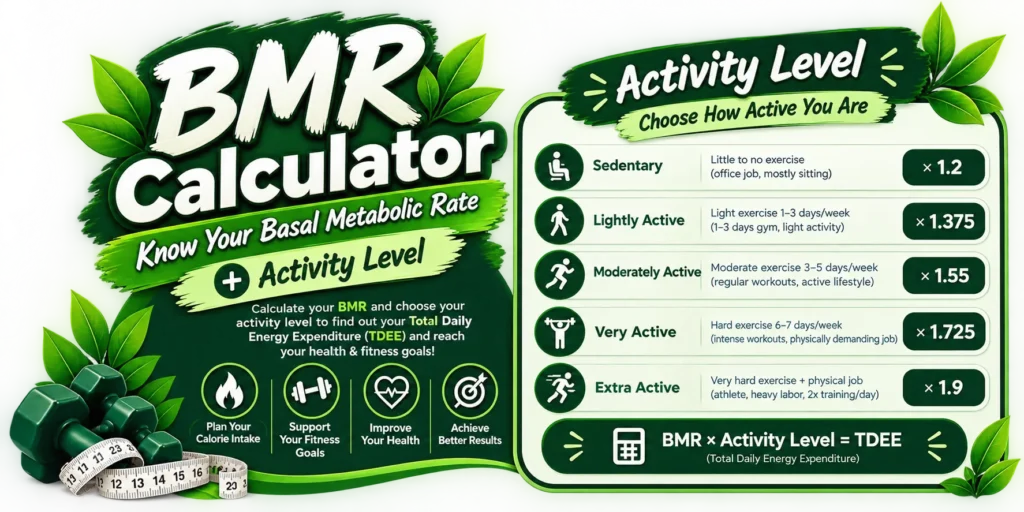
Choosing your activity level
Be honest about a normal week. Picking too high is the most common mistake.
Sedentary
Desk job, little walking and no regular workouts.
Light
Mostly seated, with short walks or 1 to 3 easy sessions weekly.
Moderate
On your feet often, plus 3 to 5 solid workouts each week.
Very active
Physical job or hard training most days of the week.
BMR is the baseline, not the target
Your BMR calculator estimates the calories your body uses for breathing, circulation, temperature regulation, and cell repair. It does not include movement or exercise. Think of it as the foundation of your energy use, then add activity to estimate your total daily calorie needs.
The BMR Formulas Explained
There is no single perfect equation, so several have been developed over the years. Here are the three most widely used.
Mifflin-St Jeor Equation
The Mifflin-St Jeor equation was published in 1990 and has become one of the most widely used formulas for estimating resting energy expenditure in nutrition and weight management. Research comparing different metabolic rate prediction equations has generally found it to be among the more accurate options for healthy adults.
Our BMR calculator uses the Mifflin-St Jeor equation to estimate how many calories your body burns at rest based on your age, sex, height, and weight. This makes it a practical starting point for understanding your body’s daily energy requirements.
Unlike older prediction formulas, the Mifflin-St Jeor equation was developed using measurements from a diverse group of adults with different body weights. However, the results are still estimates, and actual resting calorie expenditure may vary depending on muscle mass, body composition, genetics, and individual metabolic differences.
By using our BMR calculator, you can estimate your resting calorie needs and use the result as a starting point for calculating your Total Daily Energy Expenditure (TDEE). This information can help you plan your calorie intake for weight maintenance, weight loss, or muscle gain.
For men:
BMR = (10 × weight in kg) + (6.25 × height in cm) − (5 × age in years) + 5
For women:
BMR = (10 × weight in kg) + (6.25 × height in cm) − (5 × age in years) − 161
Revised Harris-Benedict Equation
The original Harris-Benedict equation dates back to 1919 and was revised in 1984. It is still popular, although it can overestimate needs for some people.
For men:
BMR = 88.362 + (13.397 × weight in kg) + (4.799 × height in cm) − (5.677 × age in years)
For women:
BMR = 447.593 + (9.247 × weight in kg) + (3.098 × height in cm) − (4.330 × age in years)
Katch-McArdle Equation
This formula ignores age, sex, and height. It uses lean body mass, which is your weight minus your body fat. It can be a good choice if you know your body fat percentage fairly accurately, for example from a reliable body composition scan.
BMR = 370 + (21.6 × lean body mass in kg)
Lean body mass = body weight × (1 − body fat percentage)
Scientific Reference
The Mifflin-St Jeor equation is a widely used method for estimating resting energy expenditure in adults. Originally published in 1990 in the American Journal of Clinical Nutrition, the equation uses age, sex, height, and weight to estimate resting calorie needs.
For more information about the scientific basis of our BMR calculator, explore the original Mifflin-St Jeor research study on PubMed.
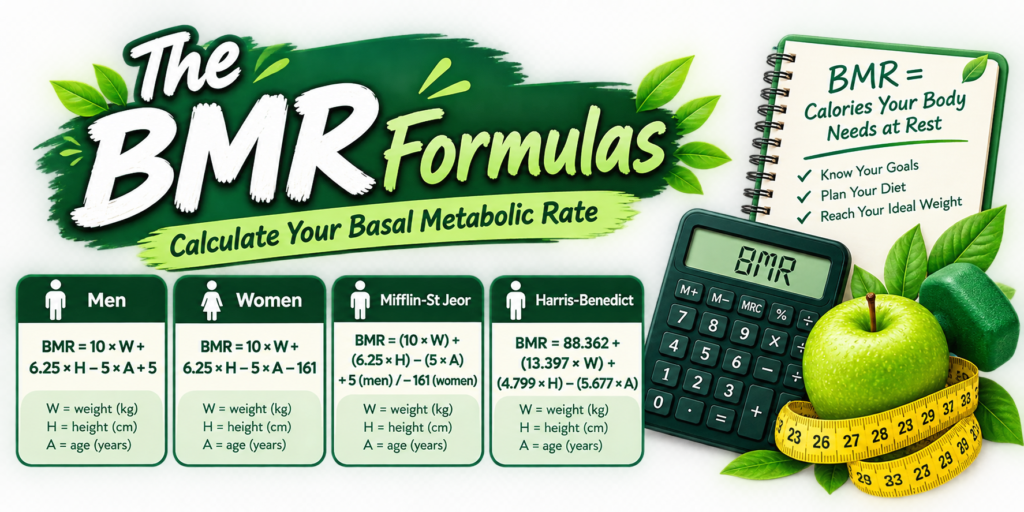
Three formulas, compared
Mifflin-St Jeor
A modern, widely used equation and a dependable default.
Men: 10 × kg + 6.25 × cm − 5 × age + 5
Women: 10 × kg + 6.25 × cm − 5 × age − 161
Revised Harris-Benedict
A long-standing equation, updated in 1984.
Men: 88.362 + 13.397 × kg + 4.799 × cm − 5.677 × age
Women: 447.593 + 9.247 × kg + 3.098 × cm − 4.330 × age
Katch-McArdle
Uses lean body mass, ideal if you know your body fat.
370 + 21.6 × lean body mass (kg)
Common BMR misunderstandings
You should eat exactly your BMR to lose weight.
Fact: Start from your daily total and use a modest deficit. Eating at BMR ignores your activity.
Your BMR never changes.
Fact: It shifts with weight, age and muscle mass, so recheck after big changes.
Many small meals speed up metabolism.
Fact: Meal frequency has little effect on total daily energy burn.
A calculator gives an exact number.
Fact: It is a close estimate. Real-world tracking over a few weeks is the best test.
What Affects Your BMR?
Two people of the same weight can have different BMRs. Our BMR calculator helps estimate these differences. Several factors explain why.
Body size. A larger body has more tissue to keep alive, so it burns more energy at rest.
- Body composition. Muscle tissue uses more energy at rest than fat tissue. A person with more muscle usually has a higher BMR than a person of the same weight with less muscle.
- Age. BMR tends to decline gradually with age, mostly because muscle mass often decreases over the years.
- Sex. On average, men have more muscle and less body fat than women of the same size, which is why the formulas give men a higher result.
- Genetics. Some people naturally run a little faster or slower, and no equation can fully capture that.
- Hormones. Thyroid hormones in particular have a strong influence on metabolic rate. Medical conditions that affect the thyroid can raise or lower BMR.
- Temperature and environment. Living in very cold conditions can raise energy use as the body works to stay warm.
- Pregnancy and breastfeeding. Energy needs rise during these periods, and standard calculators do not apply well. Speak with a doctor or dietitian.
How to Read Your BMR Result
Once you have your number from our BMR calculator, remember what it represents: the energy needed for basic survival at rest. It is not a target for daily eating and it is not a measure of how fast or slow your metabolism is in a good-or-bad sense.
A higher BMR is not automatically better and a lower BMR is not automatically a problem. It mostly reflects body size and composition. A smaller person will generally have a lower BMR than a larger person, and that can be perfectly healthy.
Using Your BMR for Weight Goals
Your BMR calculator results can help you understand your resting energy requirements and provide a starting point for planning your daily calorie intake. However, BMR alone does not determine how much you should eat. To manage your weight effectively, you also need to consider your Total Daily Energy Expenditure (TDEE), which includes physical activity, movement, and digestion.
Weight Loss
To lose body fat, you generally need to consume fewer calories than your body burns throughout the day. A moderate calorie deficit of around 10 to 20 percent below your estimated daily energy needs can be a reasonable starting point for some adults, depending on their health and nutritional requirements.
Very large calorie deficits can be difficult to maintain and may increase the risk of fatigue, muscle loss, nutrient deficiencies, and excessive hunger.
Use your BMR calculator results to estimate your resting calorie needs, then calculate your TDEE to understand your overall daily energy expenditure. Your BMR is not a universal minimum calorie intake, so choose an appropriate calorie target based on your individual circumstances rather than treating BMR as a strict cutoff.
Weight Maintenance
If you are satisfied with your current weight, your goal is to balance calorie intake with total daily energy expenditure. You can estimate your maintenance calories by multiplying the result from our BMR calculator by an appropriate activity factor.
For example, if your BMR is 1,500 calories and your activity multiplier is 1.5, your estimated maintenance requirement would be approximately 2,250 calories per day.
Monitor your body weight regularly and compare weekly averages rather than focusing on daily fluctuations. Adjust your calorie intake gradually if your weight consistently increases or decreases.
Muscle Gain
Building muscle generally requires resistance training, adequate protein, sufficient recovery, and appropriate calorie intake. A BMR calculator can help you estimate your resting energy needs as a starting point for determining maintenance calories. A modest calorie surplus of around 5 to 15 percent above estimated maintenance needs may be useful for some people, although a surplus is not always necessary.
For example, if your estimated TDEE is 2,400 calories, a 10 percent surplus would provide approximately 2,640 calories per day.
A larger calorie surplus does not necessarily produce faster muscle growth and may lead to additional fat gain.
By combining your BMR calculator results with your activity level, you can estimate your daily energy needs and develop a more informed nutrition plan for weight loss, maintenance, or muscle gain.
How to Increase Your Metabolic Rate Naturally
A BMR calculator helps estimate your resting calorie needs, but you cannot hack your metabolism overnight. Healthy habits can support it.
- Build and keep muscle. Strength training two to four times per week helps protect lean mass, which supports a higher resting burn.
- Eat enough protein. Protein supports muscle and takes more energy to digest than carbohydrates or fat.
- Do not crash diet. Severe calorie restriction can lead to muscle loss and a lower energy output.
- Move more through the day. Walking, taking stairs, and standing more all add up, even though they do not change BMR directly.
- Sleep well. Seven to nine hours of sleep supports appetite control, energy, and recovery.
- Stay hydrated. Good hydration supports normal body function, though water alone is not a magic fat burner.
How Accurate Is a BMR Calculator?
A BMR calculator uses averages from large groups of people. For many healthy adults, the estimate lands reasonably close, but individual differences can push the real value a few hundred calories higher or lower.
The best way to improve accuracy is to test your numbers in real life:
- Calculate your daily calorie needs from your BMR and activity level.
- Eat at that level consistently for two to three weeks.
- Weigh yourself at the same time each morning and track the weekly average.
- If your weight stays stable, your estimate is about right for maintenance.
- If it rises or falls more than you want, adjust your intake by 100 to 200 calories and test again.
Common Mistakes to Avoid
- Treating BMR as a calorie goal. It is a baseline, not a daily eating target.
- Ignoring activity. Forgetting to multiply by an activity factor leads to eating far too little.
- Overestimating activity level. One workout does not make a desk-bound day highly active.
- Using outdated numbers. Recalculate after you gain or lose a meaningful amount of weight, and at least once a year.
- Expecting perfect accuracy. Use the number as a starting point and refine it.
- Comparing with other people. Your BMR depends on your own body, not your friend’s.
Who Should Be Careful With BMR Calculators?
Our BMR calculator is designed to estimate the resting calorie needs of generally healthy adults. It uses established mathematical formulas based on factors such as age, sex, height, and weight. However, these equations provide estimates rather than exact measurements, and they may not accurately reflect everyone’s energy requirements.
Certain health conditions, life stages, and medications can significantly affect metabolism and nutritional needs. Therefore, standard BMR calculations may not be suitable if you are:
- Pregnant or breastfeeding: Your body requires additional energy to support pregnancy, recovery, and milk production. Standard BMR equations do not fully account for these changing nutritional needs.
- Under 18 years old: Children and teenagers have different energy requirements because their bodies are still growing and developing.
- Living with a medical condition: Health conditions, including thyroid disorders, can influence metabolism and resting energy expenditure, making standard estimates less reliable.
- Taking medication that affects metabolism or appetite: Certain medications can change energy expenditure, appetite, or body weight, which may affect your actual calorie requirements.
- Recovering from, or have a history of, disordered eating: Tracking calories or focusing heavily on metabolic numbers may be unsuitable during recovery and could interfere with healthy eating behaviors.
When Should You Seek Professional Advice?
If you fall into any of these categories, consult a qualified healthcare professional or registered dietitian before using a BMR calculator to make significant changes to your calorie intake.
A healthcare professional can consider your medical history, nutritional requirements, activity level, and individual circumstances when recommending an appropriate eating plan.
Remember, a BMR calculator is an educational tool, not a medical diagnostic test. Its results should be used as general estimates rather than strict calorie targets or personalized medical advice.
Terms worth knowing
|
BMR |
Basal metabolic rate: energy used at complete rest to sustain vital functions. |
|---|---|
|
BMR |
Resting metabolic rate: similar to BMR but measured under less strict conditions, so slightly higher. |
|
TDEE |
Total daily energy expenditure: BMR plus digestion, movement and exercise. |
|
NEAT |
Non-exercise activity thermogenesis: calories burned through daily movement like walking and fidgeting. |
|
kcal |
A kilocalorie, the unit commonly called a calorie on food labels. |