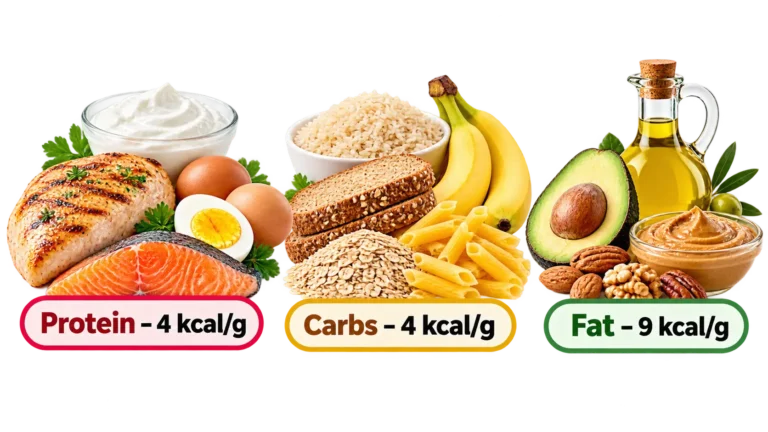
How to calculate calorie deficit?
You are eating less, skipping snacks, and the scale still will not move. In most cases the problem is not willpower. It is that nobody showed you how to calculate calorie deficit properly, so the “deficit” you are aiming for is really a guess. This guide gives you the exact formula, five simple steps and two worked examples, so you finish with a daily calorie target built around your own body instead of a generic number.
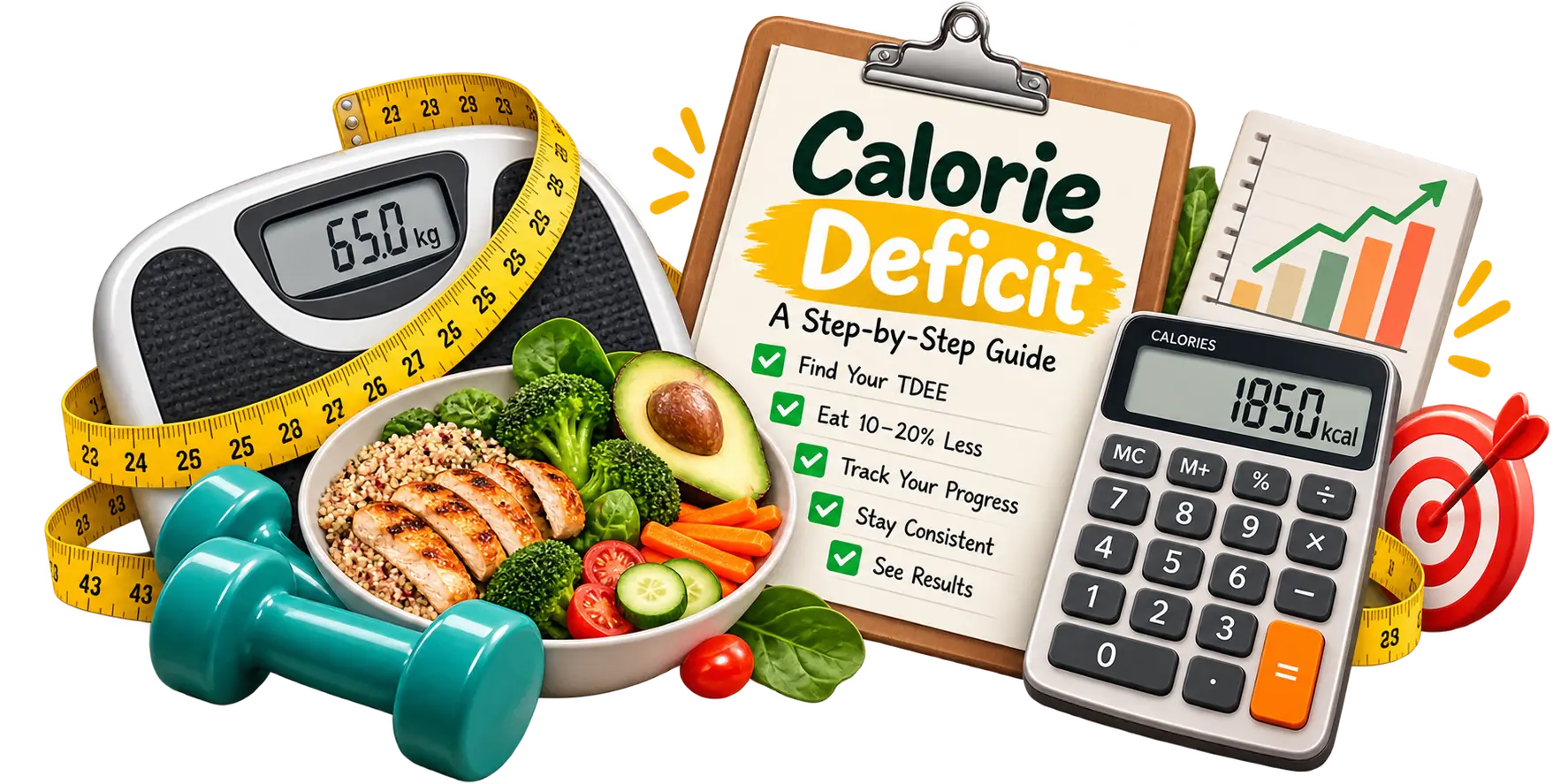
What Is a Calorie Deficit?
A calorie deficit happens when you take in fewer calories than your body uses in a day. To cover the shortfall, your body draws on stored energy, mainly body fat, and over time that is what produces weight loss. This idea is called energy balance.
There are three possible states:
- Calorie deficit: you eat less than you burn, so weight goes down.
- Maintenance: you eat about what you burn, so weight stays steady.
- Calorie surplus: you eat more than you burn, so weight goes up.
You can create a deficit by eating less, moving more, or combining both. Whichever route you choose, the first job is the same: work out how many calories you burn in a day.
The Calorie Deficit Formula
The formula is short:
Calorie deficit = TDEE − calories eaten
Daily calorie target = TDEE − the deficit you want
TDEE stands for Total Daily Energy Expenditure, the full number of calories you burn in 24 hours, including rest, digestion, daily movement and exercise. It is also called your maintenance calories. If you want the full background, read our complete TDEE guide.
How to Calculate Calorie Deficit in 5 Steps?
Follow these steps in order. If you would rather skip the maths, our free TDEE calculator does steps 1 and 2 for you in seconds.
- BMR (Mifflin-St Jeor)
- TDEE (BMR × activity)
- Deficit (10 to 20 percent)
- Target (TDEE − deficit)
- Adjust(every 2 to 3 weeks)
Step 1: Estimate your BMR
Your basal metabolic rate (BMR) is the energy your body needs at complete rest. The Mifflin-St Jeor equation is a widely used way to estimate it:
|
Sex |
BMR equation (kg, cm, years) |
|
Men |
(10 × weight) + (6.25 × height) − (5 × age) + 5 |
|
Women |
(10 × weight) + (6.25 × height) − (5 × age) − 161 |
Need the numbers explained? See our BMR calculator.
Step 2: Multiply by your activity factor to get TDEE
Your BMR only covers rest. To include daily movement and exercise, multiply it by the factor that best matches a typical week:
|
Activity level |
What it looks like |
Multiplier |
|
Sedentary |
Desk job, little or no exercise |
1.2 |
|
Lightly active |
Light exercise 1 to 3 days a week |
1.375 |
|
Moderately active |
Moderate exercise 3 to 5 days a week |
1.55 |
|
Very active |
Hard exercise 6 to 7 days a week |
1.725 |
|
Extremely active |
Very hard training plus a physical job |
1.9 |
TDEE = BMR × activity multiplier. Most people overestimate how active they are, so if you sit between two levels, choose the lower one.
Step 3: Choose the size of your deficit
For most adults, a deficit of 10 to 20 percent of TDEE is a sensible range. It is large enough to produce steady progress and small enough to keep your energy, mood and training intact. We cover this choice in detail below.
Step 4: Subtract the deficit to set your daily target
- 10 percent deficit: TDEE × 0.90
- 15 percent deficit: TDEE × 0.85
- 20 percent deficit: TDEE × 0.80
The result is your daily calorie target. Then check it against a safety floor. Many health guidelines advise against eating below roughly 1,200 calories a day for women or 1,500 for men without medical supervision. If your target falls under that, choose a smaller deficit.
Step 5: Track for 2 to 3 weeks, then adjust
Every formula is an estimate. Eat at your target for two to three weeks, weigh yourself at the same time each morning, and compare the weekly average with the previous week. If your weight is not moving the way you want, change your intake by 100 to 150 calories and test again. Recalculate your TDEE whenever you lose or gain a meaningful amount of weight.
Two Worked Examples
The following examples apply the Mifflin-St Jeor equation and the activity multipliers from Steps 1 to 4. Use them as a template for your own numbers.
Example 1: Woman, 32 years, 70 kg, 165 cm, lightly active
- BMR: (10 × 70) + (6.25 × 165) − (5 × 32) − 161 = 1,410 calories
- TDEE: 1,410 × 1.375 = 1,939 calories
- Chosen deficit: 15 percent, so 1,939 × 0.85 = 1,648 calories per day
This gives a calorie deficit of about 291 calories daily. The target sits above the 1,200-calorie safety floor, so no adjustment is needed.
Example 2: Man, 40 years, 90 kg, 178 cm, sedentary
- BMR: (10 × 90) + (6.25 × 178) − (5 × 40) + 5 = 1,818 calories
- TDEE: 1,818 × 1.2 = 2,181 calories
- Chosen deficit: 20 percent, so 2,181 × 0.80 = 1,745 calories per day
This creates a calorie deficit of roughly 436 calories daily, which is comfortably above the 1,500-calorie floor for men.
Both results are estimates. Treat them as a starting point and refine them using the tracking method in Step 5.
How Fast Will You Lose Weight?
One kilogram of body fat holds roughly 7,700 calories. This figure is an approximation, but it helps you set realistic expectations.
- Example 1: 291 calories × 7 days = 2,037 calories per week, or about 0.25 kg per week.
- Example 2: 436 calories × 7 days = 3,052 calories per week, or about 0.4 kg per week.
A steady pace of 0.25 to 0.75 kg per week is considered sustainable for most adults. Early weight changes may look faster because of water loss, and later progress often slows as your body weight drops. This is normal, and it is the reason Step 5 asks you to recalculate your TDEE after meaningful weight change.
Common Mistakes When Calculating a Calorie Deficit
- Overestimating activity level. Choosing “very active” for a desk job inflates your TDEE and erases the deficit.
- Cutting calories too low. Extreme restriction is difficult to maintain and often ends in rebound eating.
- Ignoring liquid calories. Juices, sweetened coffee and soft drinks add up quickly.
- Judging results too early. Daily weight changes are noisy. Use the weekly average instead.
- Never recalculating. Your maintenance calories fall as your weight falls, so your target needs periodic updates.
- Neglecting protein and strength training. Adequate protein and resistance exercise help preserve muscle while you lose fat.
Who Should Be Careful With a Calorie Deficit?
Calorie restriction is not appropriate for everyone. Consult a qualified healthcare professional before starting if you are pregnant or breastfeeding, under 18, living with diabetes or another medical condition, taking regular medication, or have a history of disordered eating. This article is for general information only and is not a substitute for medical advice.
Conclusion
To calculate your calorie deficit, estimate your BMR, multiply it by your activity factor to find your TDEE, and subtract a moderate 10 to 20 percent. Then track your weekly average for two to three weeks and adjust by 100 to 150 calories when needed. A realistic, steady calorie deficit is far more effective than a drastic one, because it is the version you can actually maintain.
Ready to start? Use our TDEE calculator to get your personalised daily calorie target in seconds, or read our complete TDEE guide and BMR calculator page for the full background.