Calorie Calculator
Daily Calorie Calculator
Enter your information to explore an educational estimate of your daily energy needs.
Calorie Calculator: Calculate Your Daily Calorie Needs for Weight Loss, Maintenance, and Weight Gain
Knowing how many calories your body needs each day can make it easier to understand your nutrition and manage your fitness goals. Whether you want to lose weight, maintain your current body weight, or gain weight, understanding your daily calorie requirements is an important starting point.
A Calorie Calculator is a useful online tool that estimates how much energy your body needs throughout the day. It uses information such as your age, sex, height, weight, and physical activity level to estimate your daily calorie requirements.
Your body needs energy for everything it does, from breathing and circulating blood to walking, exercising, and digesting food. The amount of energy you need depends on several individual factors, which is why calorie requirements are different for everyone.
Using a daily calorie calculator can help you understand your estimated energy needs instead of relying on general calorie recommendations. It can also help you make more informed decisions about your daily eating habits.
In this guide, you will learn how a calorie calculator works, how daily calorie needs are estimated, which formulas are commonly used, how calories relate to weight management, and what factors can affect your energy requirements.
What Is a Calorie Calculator?
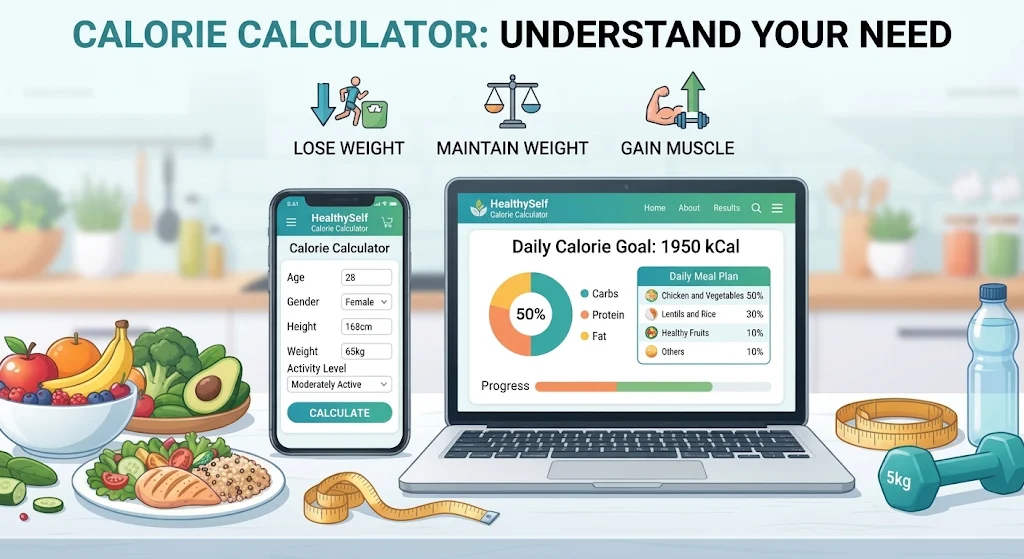
A calorie calculator is an online tool designed to estimate the number of calories your body needs each day. It considers personal information and physical activity to calculate an approximate daily energy requirement.
A calorie is a unit of energy. In nutrition, calories describe the energy that food and beverages provide to your body.
Your body uses this energy to perform essential functions, maintain normal body temperature, support physical movement, and complete everyday activities.
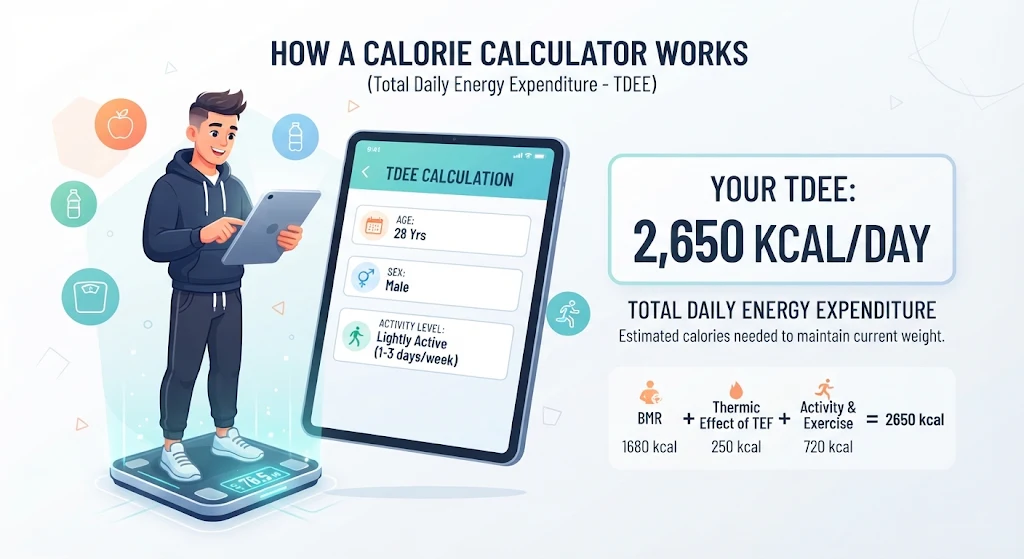
A calorie calculator generally estimates your Total Daily Energy Expenditure (TDEE). This represents the total amount of energy your body uses throughout an average day.
The calculator can help you estimate calorie intake for three common goals:
1. Weight Loss
If your goal is to lose weight, understanding your maintenance calories can help you identify an appropriate calorie deficit. A calorie deficit means consuming less energy than your body uses over time.
2. Weight Maintenance
If you want to maintain your current weight, your estimated calorie intake should be approximately equal to your daily energy expenditure over time.
3. Weight Gain
If your goal is to gain weight, consuming more calories than your body uses can create a calorie surplus. This provides additional energy that can support weight gain.
A calorie calculator provides a starting estimate for these goals. It does not guarantee a particular result because individual energy requirements can vary.
Why Is Knowing Your Daily Calorie Needs Important?
Understanding your daily calorie requirements can help you make better decisions about your eating habits and overall nutrition.
Many people focus on food choices without considering how much energy their bodies need. However, both food quality and overall energy intake matter when planning a balanced diet.
Here are some reasons why knowing your calorie requirements can be useful.
Better Understanding of Food Intake
Learning about calories can help you understand how much energy different foods provide. This can make it easier to recognize the relationship between food portions and daily energy intake.
Support for Weight Management
Your calorie intake plays an important role in long-term body weight changes. Understanding your estimated maintenance calories can help you make informed decisions about weight management.
Improved Nutrition Awareness
Calorie information can encourage you to pay attention to portion sizes, food labels, and the nutritional content of meals.
Better Fitness Planning
People who exercise regularly may have different energy requirements from people with less active lifestyles. Knowing your estimated needs can help you plan meals around your physical activity.
More Informed Eating Habits
Instead of following random diet recommendations, you can use your estimated calorie requirements as a starting point for making practical nutrition choices.
Remember that calorie awareness should support healthy habits, not create unnecessary stress about food.
How Does a Calorie Calculator Work?
A daily calorie calculator uses mathematical equations to estimate your energy requirements. Most calculators first estimate your Basal Metabolic Rate (BMR) and then adjust that value according to your activity level.
The result is an estimate of your Total Daily Energy Expenditure (TDEE).
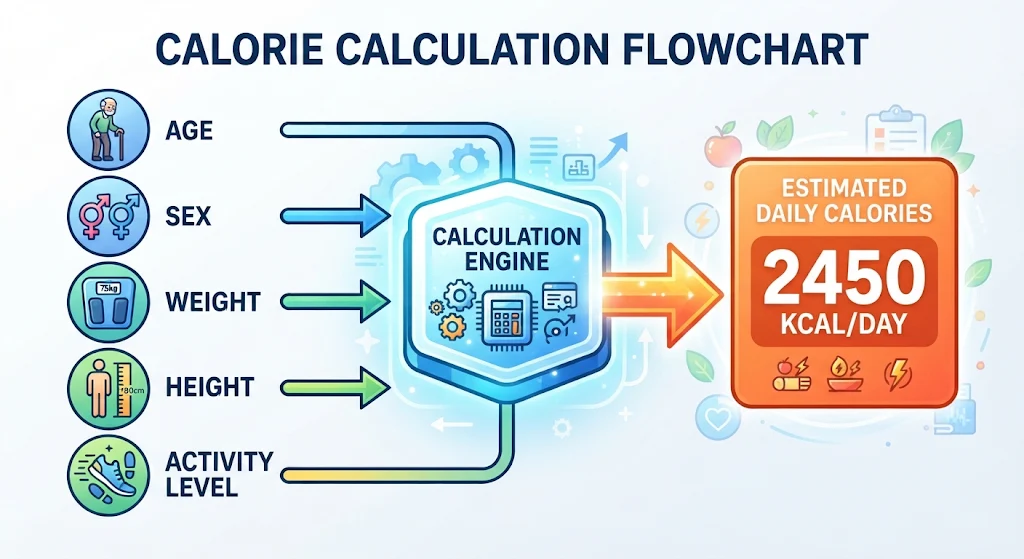
To understand this process, it is helpful to learn about the information used in the calculation.
1. Age
Age is one of the variables used in many calorie estimation equations.
Energy requirements can change throughout life because body composition, growth, activity levels, and other physiological factors may change.
For example, the energy needs of a growing teenager may differ from those of an adult.
2. Sex
Many commonly used BMR equations include sex as a calculation variable because average body composition and energy requirements can differ between populations.
3. Weight
Your current body weight helps estimate the amount of energy required to support normal body functions.
Weight is usually entered in kilograms or pounds, depending on the calculator’s measurement system.
4. Height
Height is another important variable in BMR calculations. It is commonly entered in centimeters or feet and inches.
5. Physical Activity Level
Your activity level helps estimate how much additional energy you use through exercise and everyday movement.
A person who regularly participates in sports, walking, or physically demanding work may have higher daily energy requirements than someone who spends most of the day sitting.
Once these details are entered, the calculator uses an equation and an activity multiplier to estimate daily calorie needs.
What Are Calories and How Does Your Body Use Them?
Calories measure energy. Your body obtains this energy from food and beverages and uses it to perform essential biological processes.
Even when you are sleeping or sitting quietly, your body continues using energy.
Your body needs calories for several important activities.
Basal Body Functions
Your body requires energy for breathing, blood circulation, brain activity, cell maintenance, and other essential processes.
Physical Movement
Walking, climbing stairs, exercising, cleaning, and other physical activities require energy.
Digestion
Your body also uses energy to digest, absorb, and process nutrients from food. This process is known as the Thermic Effect of Food (TEF).
Maintaining Body Temperature
Your body uses energy to maintain a stable internal temperature in different environmental conditions.
Calories are therefore not only related to exercise or weight loss. They are essential for normal daily functioning.
Understanding the Three Main Macronutrients
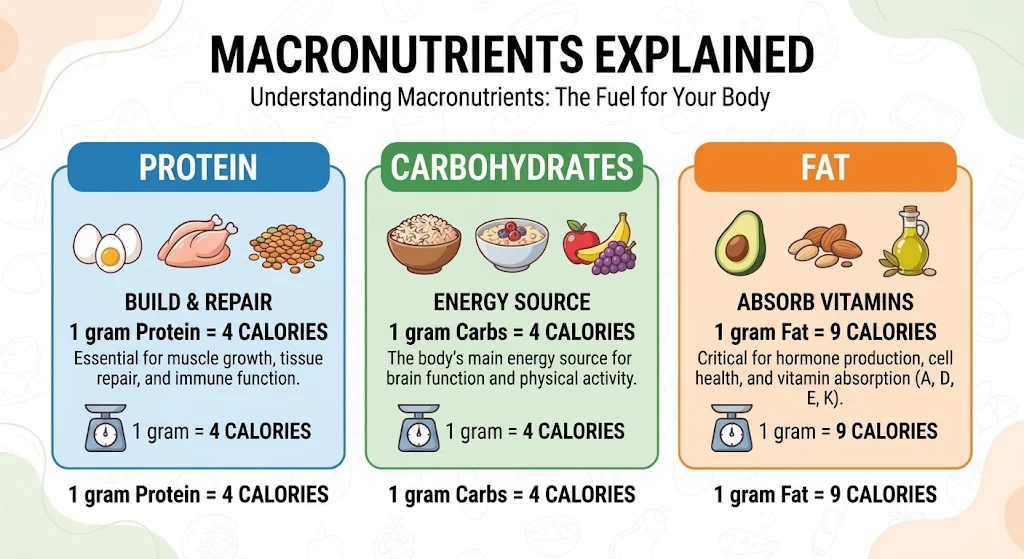
Food provides energy through three major macronutrients: protein, carbohydrates, and fat.
Each macronutrient has a different calorie value per gram.
1. Protein
Protein provides approximately 4 calories per gram.
It is important for building and repairing tissues, maintaining muscle, producing enzymes, and supporting several other body functions.
Common protein-rich foods include:
- Eggs
- Chicken
- Fish
- Milk
- Yogurt
- Beans
- Lentils
- Nuts
Protein calulator is especially important when planning balanced meals and supporting muscle maintenance.
2. Carbohydrates
Carbohydrates provide approximately 4 calories per gram.
They are an important energy source for the body, particularly during physical activity.
Common carbohydrate sources include:
- Rice
- Bread
- Potatoes
- Oats
- Fruits
- Vegetables
- Whole grains
Choosing fiber-rich carbohydrate sources can support digestive health and overall nutrition.
3. Fat
Fat provides approximately 9 calories per gram.
Dietary fat helps the body absorb certain vitamins, supports cell function, and provides a concentrated source of energy.
Common sources include:
- Olive oil
- Avocados
- Nuts
- Seeds
- Fatty fish
- Peanut butter
Fat is an essential part of a balanced diet, although portion sizes matter because it provides more calories per gram than protein or carbohydrates.

Calories Per Gram of Macronutrients
Macronutrient | Calories Per Gram |
|---|---|
Protein | 4 kcal |
Carbohydrates | 4 kcal |
Fat | 9 kcal |
These values are commonly known as the 4-4-9 rule.
What Is Basal Metabolic Rate (BMR)?
Basal Metabolic Rate, or BMR, is the estimated amount of energy your body requires at complete rest to maintain essential physiological functions.
These functions include:
- Breathing
- Blood circulation
- Brain activity
- Cell maintenance
- Maintaining body temperature
- Supporting organ function
BMR represents a major part of daily energy expenditure.
It does not include the full energy cost of walking, exercising, working, or performing other daily activities.
This is why a calorie calculator generally uses BMR as a starting point and then adjusts it based on physical activity.
You can use our BMR Calculator to estimate your basal metabolic rate separately.
What Is Total Daily Energy Expenditure (TDEE)?
Total Daily Energy Expenditure, commonly called TDEE, is the estimated total number of calories your body burns throughout the day.
Unlike BMR, TDEE considers more than the energy required at rest.
It includes several components.
1. Basal Metabolic Rate (BMR)
BMR represents the energy used for essential body functions while at rest.
2. Physical Activity
This includes structured exercise and everyday movement, such as walking, cycling, climbing stairs, and household activities.
3. Thermic Effect of Food (TEF)
TEF is the energy your body uses to digest, absorb, and process food.
4. Non-Exercise Activity Thermogenesis (NEAT)
NEAT refers to the energy used for activities that are not formal exercise.
Examples include:
- Walking around the house
- Standing
- Cleaning
- Cooking
- Gardening
- Moving during work
Together, these components contribute to your total daily energy expenditure.
How to Calculate Daily Calorie Needs
Daily calorie needs can be estimated using a two-step process.
First, calculate BMR. Then multiply BMR by an activity factor to estimate TDEE.
Step 1: Calculate BMR Using the Mifflin-St Jeor Equation
The Mifflin-St Jeor equation is a commonly used method for estimating resting energy expenditure in adults.
For Men:
BMR = (10 × Weight in kg) + (6.25 × Height in cm) − (5 × Age) + 5
For Women:
BMR = (10 × Weight in kg) + (6.25 × Height in cm) − (5 × Age) − 161
Where:
- Weight is measured in kilograms.
- Height is measured in centimeters.
- Age is measured in years.
Example: BMR Calculation for a Man
Suppose a man has the following measurements:
- Age: 25 years
- Weight: 70 kg
- Height: 175 cm
Using the Mifflin-St Jeor equation:
BMR = (10 × 70) + (6.25 × 175) − (5 × 25) + 5
BMR = 700 + 1093.75 − 125 + 5
BMR = 1673.75 calories per day
His estimated BMR is approximately 1,674 calories per day.
This is an estimate of his resting energy requirements, not his complete daily calorie needs.
Step 2: Multiply BMR by Your Activity Factor
After calculating BMR, multiply it by an activity factor.
TDEE = BMR × Activity Factor
The activity factor estimates additional energy expenditure associated with your usual activity level.
Common activity multipliers are:
Activity Level | Activity Factor |
|---|---|
Sedentary | 1.2 |
Lightly Active | 1.375 |
Moderately Active | 1.55 |
Very Active | 1.725 |
Extra Active | 1.9 |
Example: TDEE Calculation
Suppose the estimated BMR is 1,674 calories and the person is moderately active.
TDEE = 1,674 × 1.55
TDEE = 2,594.7 calories per day
The estimated daily energy expenditure is approximately 2,595 calories.
This means that around 2,595 calories per day may represent the person’s estimated maintenance requirement.
Actual calorie needs can differ because activity multipliers are broad estimates.
Different Activity Levels Explained
Choosing the correct activity level is important because it can significantly affect your estimated calorie requirements.
Here is what common activity categories generally mean.
Sedentary
A sedentary lifestyle involves little planned exercise and limited daily movement.
Examples include:
- Working at a desk
- Studying for long periods
- Spending most of the day sitting
- Limited walking
The commonly used activity multiplier is 1.2.
Lightly Active
This category generally includes light exercise or physical activity on approximately one to three days per week.
Examples include:
- Casual walking
- Light cycling
- Short exercise sessions
- Occasional recreational activities
The commonly used activity multiplier is 1.375.
Moderately Active
Moderate activity generally involves regular exercise or physical activity on approximately three to five days per week.
Examples include:
- Regular gym workouts
- Jogging
- Swimming
- Cycling
- Sports activities
The commonly used activity multiplier is 1.55.
Very Active
A very active lifestyle generally involves hard exercise or physically demanding activities on most days.
Examples include:
- Intensive training
- Frequent sports practice
- Physically demanding work
- Long exercise sessions
The commonly used activity multiplier is 1.725.
Extra Active
This category is generally intended for people with very high physical demands, such as intensive training combined with physically demanding work.
The commonly used activity multiplier is 1.9.
These categories are general guidelines. Choose the level that best represents your normal routine rather than your most active day.
Calorie Calculator for Weight Loss
A calorie calculator can help estimate the maintenance calories that provide a starting point for understanding weight loss.
Weight loss generally occurs when your body uses more energy than you consume over time.
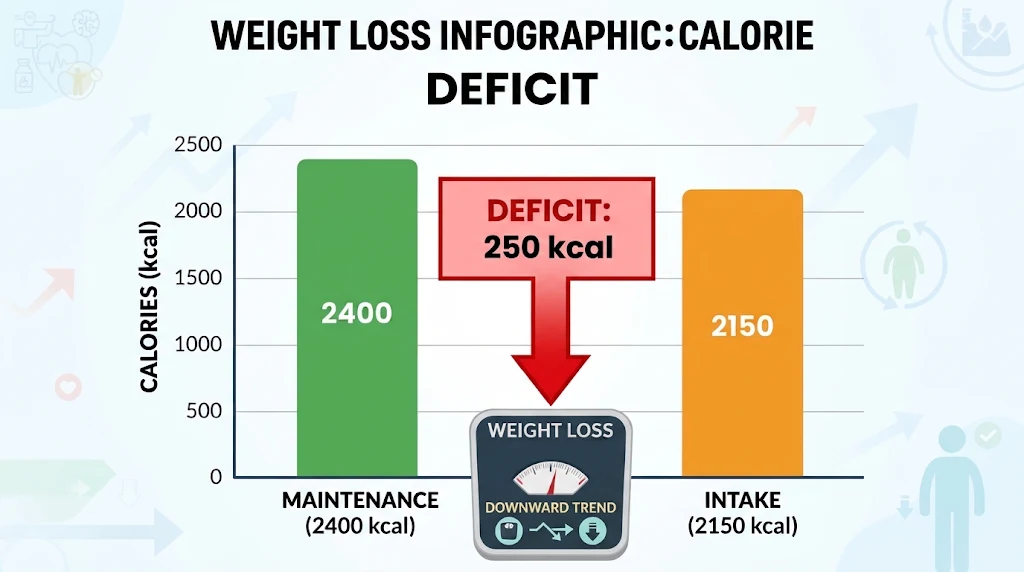
This difference is called a calorie deficit.
For example:
- Estimated maintenance calories: 2,400 kcal
- Daily calorie intake: 2,150 kcal
- Estimated calorie deficit: 250 kcal
In this example, the estimated daily deficit is 250 calories.
However, weight loss is influenced by several factors, including changes in body weight, activity, appetite, sleep, and individual metabolism.
How to Create a Sustainable Calorie Deficit
A moderate and manageable approach is generally more practical than extreme calorie restriction.
Consider these habits:
- Include vegetables and fruits in your meals.
- Choose protein-rich foods.
- Pay attention to portion sizes.
- Limit frequent consumption of highly processed foods.
- Stay physically active.
- Maintain regular sleep habits.
- Monitor longer-term progress.
Avoid very low-calorie diets without professional supervision. Your body still needs enough energy and nutrients to function properly.
Calorie Calculator for Weight Maintenance
Weight maintenance means keeping your body weight relatively stable over time.
To estimate maintenance calories, you can use your TDEE.
For example:
If your estimated TDEE is 2,300 calories per day, approximately 2,300 calories may be a starting estimate for maintaining your current weight.
However, daily calorie needs are not perfectly fixed.
Your actual energy expenditure may change with:
- Physical activity
- Changes in body weight
- Age
- Muscle mass
- Lifestyle
- Health circumstances
Instead of focusing on a single day’s intake, consider longer-term patterns.
Calorie Calculator for Weight Gain
Weight gain generally requires a calorie surplus.
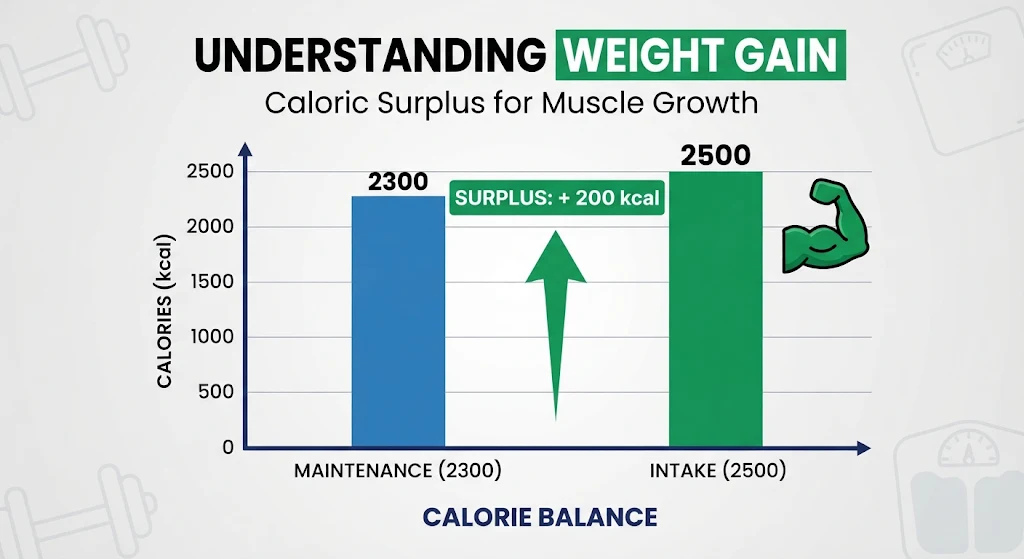
A calorie surplus means consuming more energy than your body uses over time.
For example:
- Estimated maintenance calories: 2,300 kcal
- Daily calorie intake: 2,500 kcal
- Estimated surplus: 200 kcal
This example represents a daily surplus of approximately 200 calories.
For people who want to gain weight, eating balanced and nutrient-dense meals is important.
Some useful food choices include:
- Milk and yogurt
- Eggs
- Rice
- Oats
- Nuts and seeds
- Avocados
- Beans and lentils
- Fish and chicken
Combining appropriate nutrition with resistance exercise may help support muscle development.
How Many Calories Do You Need Per Day?
There is no single calorie requirement that applies to every person.
Your daily calorie needs depend on several factors, including age, sex, height, weight, physical activity, body composition, and health status.
For example, two people who have the same body weight may have different calorie requirements because one person may be more physically active.
General population calorie estimates can provide background information, but they should not replace an individual calculation.
A personalized calorie calculator provides a more useful starting estimate by considering your measurements and activity level.
What Is the Difference Between a Calorie Calculator and a TDEE Calculator?
A calorie calculator estimates daily calorie requirements. A TDEE calculator specifically estimates the total energy your body uses throughout the day.
Many calorie calculators use a TDEE-based method.
Feature | Calorie Calculator |
|---|---|
Main Purpose | Estimate daily calorie needs |
Uses BMR | Often |
Uses Activity Level | Usually |
Weight Management | Can support planning |
Main Result | Estimated daily calories |
The two tools are closely related and may provide similar results.
If you want to understand the relationship between resting energy expenditure and daily activity, visit our TDEE Calculator.
Calories for Different Age Groups
Age is one factor that influences energy requirements.
However, calorie needs also depend on body size, physical activity, growth, and other individual characteristics.
Children and Teenagers
Children and teenagers need energy for growth, development, and everyday activities.
Their calorie requirements can change significantly during different growth stages.
A standard adult calorie calculator should not be used as the sole guide for children or teenagers.
Adults
Adult calorie requirements vary according to body size, activity level, sex, and lifestyle.
An adult calorie calculator can provide an initial estimate using an appropriate equation.
Older Adults
Energy requirements may change with age because of changes in muscle mass, body composition, and physical activity.
Older adults still need sufficient energy and essential nutrients to support health and maintain strength.
Individual advice from a qualified healthcare professional can be helpful when planning nutritional changes.
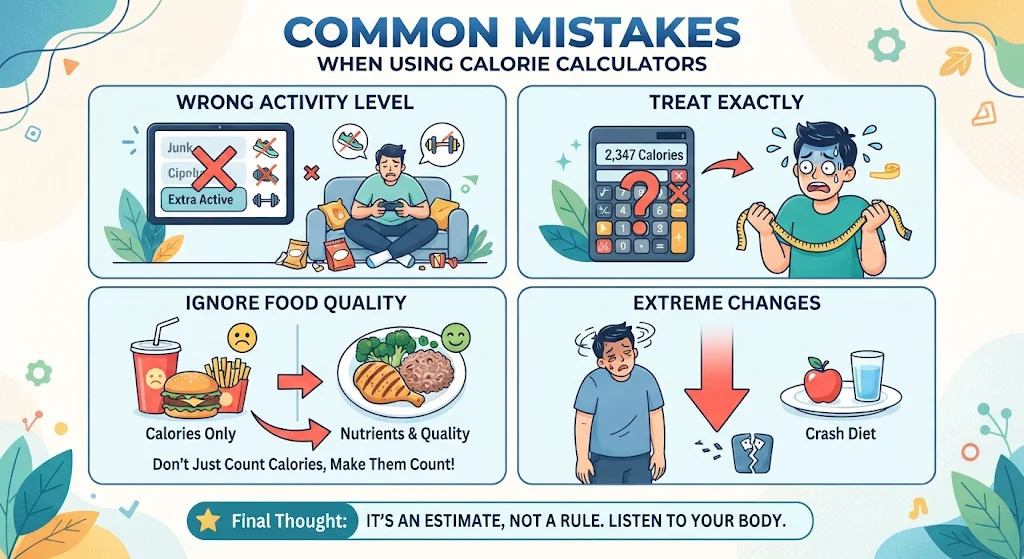
Common Mistakes When Using a Calorie Calculator
A calorie calculator can be useful, but incorrect information or unrealistic expectations may affect how you interpret the results.
Here are some common mistakes to avoid.
1. Selecting the Wrong Activity Level
Choosing an activity level that does not match your normal lifestyle can lead to an inaccurate estimate.
For example, selecting very active when you exercise only occasionally may overestimate your daily calorie needs.
2. Entering Incorrect Measurements
Incorrect weight, height, or age information can affect the calculation.
Always check your measurements before using the calculator.
3. Treating the Result as an Exact Number
Calorie calculators use mathematical equations. They do not directly measure your metabolism or daily energy expenditure.
Treat the result as an estimate rather than an exact requirement.
4. Ignoring Food Quality
Calories are important, but nutritional quality also matters.
A balanced diet should provide enough protein, carbohydrates, fats, vitamins, minerals, and fiber.
5. Making Extreme Dietary Changes
Very restrictive eating plans may make it difficult to meet your nutritional needs.
Avoid making major dietary changes based only on an online calculator.
6. Ignoring Changes in Your Lifestyle
Your energy requirements may change when your body weight, exercise routine, or daily activity changes.
Reassessing your estimated needs can help keep your nutrition plan relevant.
How to Track Your Daily Calorie Intake
Tracking your daily calorie intake can help you understand your eating habits.
If you choose to track calories, focus on consistency and realistic portion estimates.
Read Food Nutrition Labels
Food labels usually provide information about serving sizes, calories, and nutrients.
Check the serving size before interpreting the calorie information.
Measure Portions When Needed
Measuring portions can help you understand how much food you are eating.
You do not need to measure every meal permanently. It can simply be a learning tool.
Include Snacks and Drinks
Snacks, juices, sweetened beverages, sauces, and other additions can contribute to your daily energy intake.
Remember to consider them when reviewing your overall eating habits.
Focus on Long-Term Patterns
Daily calorie intake naturally changes from one day to another.
Look at your overall habits rather than worrying about small daily differences.
Avoid Obsessive Tracking
Calorie tracking is not suitable for everyone. If it creates anxiety or negatively affects your relationship with food, consider other approaches to healthy eating with professional support.
How to Improve Your Nutrition Alongside Calorie Management
Managing calories is only one part of a healthy lifestyle.
Your body also needs a variety of nutrients to support normal functions.
Here are some practical ways to improve overall nutrition.
Eat a Variety of Foods
Include different food groups in your meals to obtain a wide range of nutrients.
Choose Fiber-Rich Foods
Fruits, vegetables, legumes, and whole grains provide dietary fiber, which supports digestive health.
Include Healthy Fat Sources
Foods such as nuts, seeds, olive oil, and fish can provide dietary fats.
Eat Enough Protein
Protein supports tissue repair and muscle maintenance. Include suitable sources throughout your diet.
Stay Hydrated
Water supports many essential body functions. Your fluid requirements can vary depending on activity, climate, and individual circumstances.
Maintain Regular Physical Activity
Walking, cycling, strength training, and other activities can support overall health.
Choose activities that are appropriate for your fitness level and health condition.
Calorie Calculator vs. BMI Calculator
A calorie calculator and BMI calculator provide different types of information.
A calorie calculator estimates daily energy requirements, while a BMI calculator uses height and weight to calculate Body Mass Index.
Feature | Calorie Calculator |
|---|---|
Main Purpose | Estimate calorie requirements |
Uses Height | Yes |
Uses Weight | Yes |
Uses Activity Level | Usually |
Main Result | Daily calories |
BMI is a screening measurement and does not directly measure body fat or overall health.
You can use our BMI Calculator to calculate your BMI separately.
How Does a Macro Calculator Relate to Daily Calories?
A macro calculator helps estimate the amount of protein, carbohydrates, and fat in a person’s daily diet.
These nutrients provide most of the energy in food.
Since protein and carbohydrates provide approximately 4 calories per gram and fat provides approximately 9 calories per gram, your macronutrient intake contributes to your total calorie intake.
For example, a meal containing protein, carbohydrates, and fat provides energy from all three macronutrients.
A macro calculator can help you understand how daily calories may be divided between these nutrients.
If you want to explore macronutrient distribution, try our Macro Calculator and Protein Calculator.
Frequently Asked Questions
Final Thoughts
Understanding your daily calorie requirements can help you make more informed decisions about nutrition and fitness. A calorie calculator provides a convenient way to estimate how much energy your body needs based on your personal measurements and physical activity.
Whether your goal is weight loss, weight maintenance, or weight gain, knowing your estimated maintenance calories is a useful starting point.
Remember that calorie requirements are not identical for everyone. Your body composition, lifestyle, activity level, and health circumstances all play a role in determining your energy needs.
Use our free calorie calculator to estimate your daily calorie requirements and explore our related TDEE, BMR, BMI, Macro, Calorie and Protein Calculators to learn more about your nutrition.
Health Disclaimer: This calorie calculator provides general estimates for educational and informational purposes only. It does not diagnose, treat, or prevent any medical condition. Individual energy requirements may vary. Consult a qualified healthcare professional or registered dietitian before making significant dietary changes, especially if you are pregnant, breastfeeding, under 18, have a medical condition, or have specific nutritional needs.