Mifflin-St Jeor Equation
Mifflin-St Jeor Equation: Formula, Examples, and How to Calculate Your Daily Calorie Needs
Introduction
Understanding how many calories your body needs each day is an important part of maintaining a healthy lifestyle. Whether your goal is to maintain your current weight, lose excess body fat, or build muscle, knowing how your body uses energy can help you make more informed nutrition decisions.
One of the most widely used methods for estimating resting calorie requirements is the Mifflin-St Jeor equation. This mathematical formula estimates how much energy your body uses while resting to perform essential functions such as breathing, circulating blood, maintaining body temperature, and supporting normal organ activity.
The Mifflin-St Jeor equation uses four important measurements: age, body weight, height, and sex. By entering these details into the formula, you can estimate your resting energy expenditure (BMI, which provides a starting point for understanding your daily calorie requirements.
In this guide, you will learn what the Mifflin-St Jeor equation is, how its formulas work for males and females, how to calculate your results step by step, and how to use the estimated value to understand your total daily energy expenditure (TDEE).
What Is the Mifflin-St Jeor Equation?
The Mifflin-St Jeor equation is a scientific formula developed to estimate resting energy expenditure in adults. It was introduced in 1990 by researchers Mark D. Mifflin, Sachiko T. St Jeor, and their research colleagues.
The researchers developed this equation using measurements from 498 healthy adults, including 251 males and 247 females. Their resting energy expenditure was measured using indirect calorimetry, a scientific method that estimates energy expenditure by analyzing oxygen consumption and carbon dioxide production.
The formula uses body weight, height, age, and sex to estimate how many calories the body burns at rest.
Unlike a simple calorie estimate based only on body weight, this equation considers multiple personal measurements to produce a more individualized result.
Today, the Mifflin-St Jeor formula is commonly used in nutrition practice, calorie calculators, and weight-management planning.
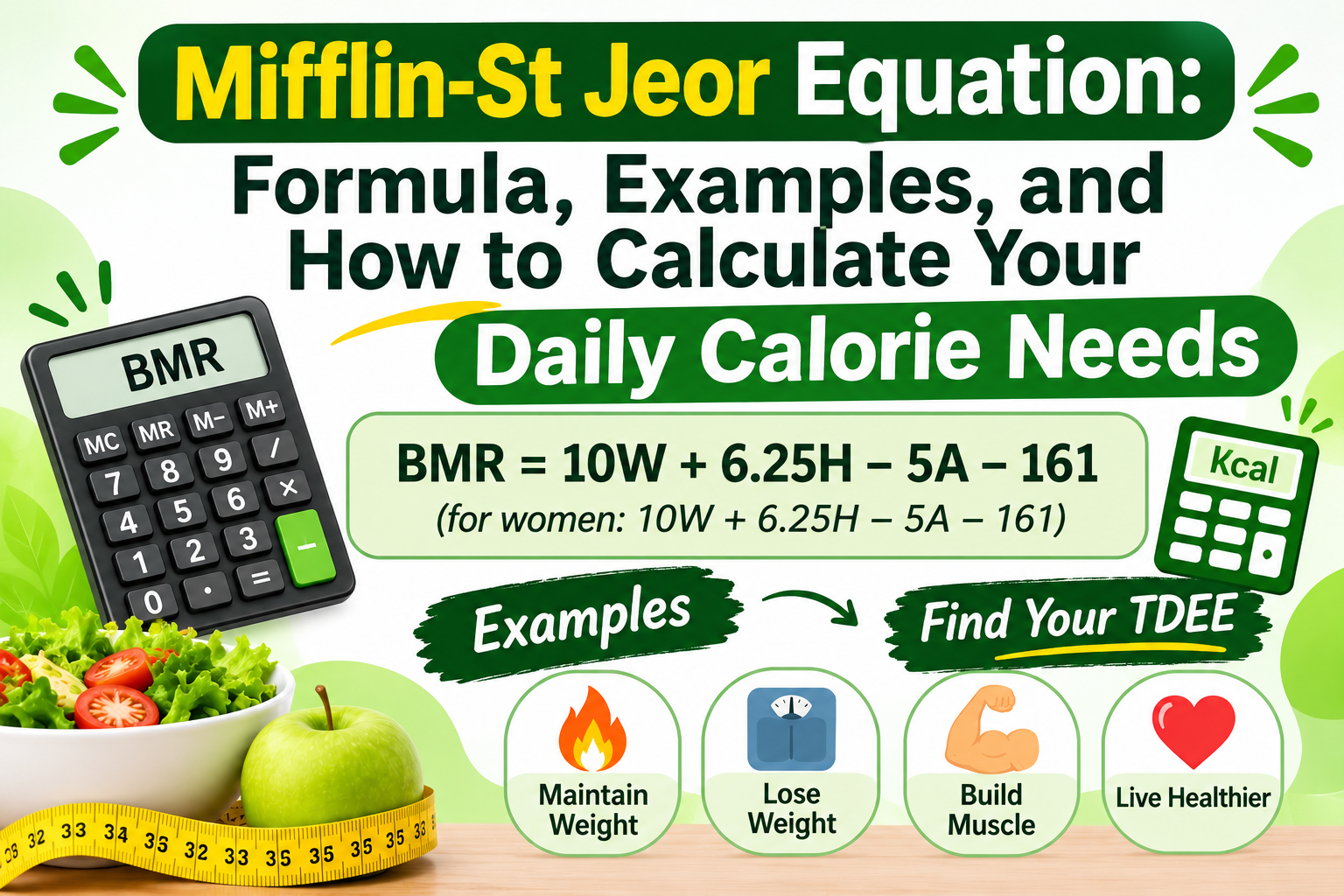
Mifflin-St Jeor Equation Formula
The Mifflin-St Jeor equation has two commonly used versions: one for males and another for females.
Both formulas use the same measurements, but the final adjustment is different.
1. Mifflin-St Jeor Equation for Males
The formula for males is:
BMI = (10 × Weight in kg) + (6.25 × Height in cm) − (5 × Age in years) + 5
Where:
- Weight is measured in kilograms.
- Height is measured in centimeters.
- Age is measured in years.
- The final result is estimated calories per day.
2. Mifflin-St Jeor Equation for Females
The formula for females is:
BMI = (10 × Weight in kg) + (6.25 × Height in cm) − (5 × Age in years) − 161
Where:
- Weight is measured in kilograms.
- Height is measured in centimeters.
- Age is measured in years.
- The final result is estimated calories per day.
Important: Both equations produce an estimated resting energy expenditure in kcal per day. They do not directly calculate the total calories you burn through your daily activities.
Understanding the Variables in the Mifflin-St Jeor Formula
Before using the equation, it is helpful to understand how each measurement contributes to the calculation.
Body Weight
Body weight is an important factor in estimating resting energy expenditure. The formula uses weight in kilograms.
For example, if your weight is 70 pounds, you must convert it into kilograms before using the standard formula.
To convert pounds into kilograms:
Weight in kg = Weight in pounds ÷ 2.20462
Height
Height is another important measurement used in the equation. Taller individuals may have different resting energy requirements because body size influences energy expenditure.
The formula requires height in centimeters.
To convert inches into centimeters:
Height in cm = Height in inches × 2.54
Age
Age also affects the estimated resting energy expenditure.
As people grow older, changes in body composition and other physiological factors may influence how much energy their bodies use at rest.
The formula subtracts five times the person’s age from the calculation.
Sex
The equation includes different final adjustments for males and females.
- Males: +5
- Females: −161
These adjustments reflect average differences observed in the original research population. They do not represent every individual’s body composition or metabolic characteristics.
How to Calculate the Mifflin-St Jeor Equation Step by Step
Calculating your resting energy expenditure is straightforward when you have your basic measurements.
Follow these steps to estimate your result.
Step 1: Collect Your Personal Information
First, collect the following information:
- Age in years
- Weight in kilograms
- Height in centimeters
- The sex category required by the equation
Make sure your measurements are accurate because incorrect information can change the estimated result.
Step 2: Select the Correct Formula
Choose the male or female version of the Mifflin-St Jeor equation.
Do not combine the final adjustments from both formulas.
Step 3: Enter Your Measurements
Multiply your weight by 10.
Next, multiply your height by 6.25.
Then multiply your age by 5.
Step 4: Complete the Calculation
Add the weight and height results together.
Subtract the age result.
Finally, add 5 for males or subtract 161 for females.
Step 5: Understand Your Result
Your final result represents estimated resting energy expenditure in calories per day.
It gives you an idea of how much energy your body may use at rest, but it does not include all the calories burned through exercise, walking, working, or other daily activities.
Mifflin-St Jeor Equation Calculation Examples
Let’s understand how the formula works with practical examples.
Example 1: Male Calculation
Suppose a male has the following measurements:
- Age: 30 years
- Weight: 80 kg
- Height: 180 cm
Using the male formula:
BMI= (10 × Weight) + (6.25 × Height) − (5 × Age) + 5
Enter the measurements:
BMI = (10 × 80) + (6.25 × 180) − (5 × 30) + 5
Calculate each part:
- 10 × 80 = 800
- 6.25 × 180 = 1,125
- 5 × 30 = 150
Now combine the results:
BMI = 800 + 1,125 − 150 + 5
BMI = 1,780 kcal/day
This means the estimated resting energy expenditure for this example is approximately 1,780 calories per day.
Example 2: Female Calculation
Suppose a female has the following measurements:
- Age: 30 years
- Weight: 65 kg
- Height: 165 cm
Using the female formula:
REE = (10 × Weight) + (6.25 × Height) − (5 × Age) − 161
Enter the measurements:
REE = (10 × 65) + (6.25 × 165) − (5 × 30) − 161
Calculate each part:
- 10 × 65 = 650
- 6.25 × 165 = 1,031.25
- 5 × 30 = 150
Now combine the results:
BMI = 650 + 1,031.25 − 150 − 161
BMI = 1,370.25 kcal/day
The estimated resting energy expenditure in this example is approximately 1,370 calories per day.
These examples demonstrate how the equation uses personal measurements to estimate resting calorie requirements.
What Is Resting Energy Expenditure (REE)?
Resting energy expenditure refers to the energy your body uses while resting to maintain essential physiological functions.
Even when you are sitting or lying down, your body continues using energy.
These functions include:
- Breathing and maintaining lung function
- Pumping blood throughout the body
- Supporting brain activity
- Maintaining body temperature
- Repairing and maintaining body tissues
- Supporting normal organ functions
REE is an important part of your total daily energy expenditure.
However, macronutrient ratio is not exactly the same as basal metabolic rate (BMR).
Difference Between BMR and REe
REE and BMR are closely related concepts, but they are not identical.
Basal metabolic rate measures the energy required to maintain essential body functions under strict laboratory conditions. These conditions typically involve an overnight fast, complete physical rest, and a controlled environment.
Resting energy expenditure is measured under less restrictive resting conditions. Therefore, REE measurements may be slightly higher than BMR measurements.
Although the terms are sometimes used interchangeably in online calculators, it is scientifically more accurate to describe the Mifflin-St Jeor equation as an REE or resting metabolic rate prediction equation.
Understanding this difference helps you interpret calculator results more accurately.
Mifflin-St Jeor Equation vs. TDEE
One common misunderstanding is that the Mifflin-St Jeor equation calculates all the calories your body burns in a day.
It does not.
The equation estimates resting energy expenditure. To estimate total daily energy expenditure, you also need to consider your physical activity.
TDEE represents the total energy your body uses throughout the day.
It includes several components:
1. Resting Energy Expenditure
This is the energy your body uses to maintain essential functions while resting.
2. Physical Activity
This includes structured exercise and everyday movements such as walking, climbing stairs, household activities, and working.
3. Thermic Effect of Food
Your body uses energy to digest, absorb, and process the food you eat.
4. Non-Exercise Activity Thermogenesis
Often called NEAT, this includes everyday movements that are not planned exercise, such as standing, cleaning, cooking, and moving around.
All these components contribute to your total daily energy expenditure.
How to Estimate TDEE Using Mifflin-St Jeor
After calculating your resting energy expenditure, you can estimate TDEE by multiplying it by an activity factor.
TDEE = REE × Activity Factor
Commonly used illustrative activity multipliers include:
Activity Level | Activity Factor |
|---|---|
Sedentary (little or no exercise) | 1.20 |
Lightly Active (light exercise 1–3 days weekly) | 1.375 |
Moderately Active (moderate exercise 3–5 days weekly) | 1.55 |
Very Active (hard exercise 6–7 days weekly) | 1.725 |
Extra Active (very hard activity or physical work) | 1.90 |
These multipliers are estimates rather than exact measurements. Actual energy expenditure varies between individuals.
Example of TDEE Calculation
Suppose your estimated REE is 1,780 calories per day and your activity level is moderately active.
TDEE = REE × Activity Factor
TDEE = 1,780 × 1.55
TDEE = 2,759 kcal/day
This means your estimated total daily energy expenditure is approximately 2,759 calories.
You can use this estimate as a starting point when planning your daily calorie intake.
To calculate your personal daily calorie needs, try a TDEE Calculator.
How Accurate Is the Mifflin-St Jeor Equation?
The Mifflin-St Jeor equation is considered one of the more reliable commonly used formulas for estimating resting metabolic rate in adults.
A systematic review published in 2005 compared several predictive equations, including Mifflin-St Jeor, Harris-Benedict, and Owen.
The review found that Mifflin-St Jeor was more likely than the other evaluated equations to estimate measured resting metabolic rate within 10% for both non-obese and obese adults.
However, this does not mean that the equation is perfectly accurate for everyone.
Individual results can differ because of several factors, including:
- Differences in body composition
- Muscle mass and fat mass
- Age and physiological changes
- Health conditions
- Hormonal factors
- Individual metabolic differences
The original research also explained approximately 71% of the variation in measured resting energy expenditure, showing that the equation is useful but cannot capture every individual’s metabolic needs.
For greater precision, indirect calorimetry can measure resting energy expenditure directly under an appropriate clinical protocol.
Advantages of the Mifflin-St Jeor Equation
The Mifflin-St Jeor equation offers several benefits for estimating resting calorie requirements.
1. Easy to Calculate
The formula is straightforward and requires only a few personal measurements.
You do not need specialized equipment to calculate an estimate.
2. Uses Multiple Personal Measurements
The equation considers weight, height, age, and sex instead of relying only on body weight.
3. Supported by Scientific Research
The formula was developed using measured resting energy expenditure from a research group of 498 healthy adults.
4. Useful for Weight Management
The estimated resting energy expenditure can be used as a starting point for estimating total daily calorie requirements.
5. Available in Online Calculators
Many nutrition and fitness calculators use this equation to help users estimate resting energy needs without performing manual calculations.
Limitations of the Mifflin-St Jeor Equation
Although the Mifflin-St Jeor equation is useful, it has some limitations that users should understand.
1. It Provides an Estimate
The formula predicts resting energy expenditure rather than measuring it directly.
Your actual energy requirements may be higher or lower than the calculated result.
2. It Does Not Directly Measure Muscle Mass
Two people with the same weight, height, age, and sex may have different body compositions.
For example, someone with more muscle mass may have different resting energy requirements than someone with more body fat.
The standard equation does not directly account for these differences.
3. It Does Not Include Physical Activity
The formula estimates energy expenditure at rest. It does not calculate the additional energy used during exercise or daily movement.
You need an activity factor to estimate TDEE.
4. It May Be Less Reliable for Some Populations
The original study included healthy adults aged 19–78 years.
Its accuracy may vary in populations that were underrepresented in the original research and in people with certain health conditions.
5. Individual Health Conditions Can Affect Results
Medical conditions, medications, hormonal changes, and other physiological factors may influence energy expenditure.
People with specific medical or nutritional needs should seek professional guidance rather than relying only on a calculator.
Mifflin-St Jeor vs. Harris-Benedict Equation
The Harris-Benedict equation is another commonly known method for estimating resting calorie requirements.
It was originally introduced in 1919, while the Mifflin-St Jeor equation was published in 1990.
Both formulas use measurements such as age, height, weight, and sex, but they have different mathematical coefficients.
Here is a simple comparison:
Feature | Mifflin-St Jeor | Harris-Benedict |
|---|---|---|
Introduced | 1990 | 1919 |
Main purpose | Estimate REE | Estimate BMR |
Uses weight | Yes | Yes |
Uses height | Yes | Yes |
Uses age | Yes | Yes |
Uses sex-specific formulas | Yes | Yes |
Research background | Developed using 498 adults | Developed using 136 adults |
The Mifflin-St Jeor equation performed better than several older equations in a 2005 systematic review of predictive methods.
However, neither formula provides a perfect measurement for every person.
The most appropriate method depends on the individual and the purpose of the calculation.
How to Use a Mifflin-St Jeor Calculator
An online Mifflin-St Jeor calculator makes the calculation easier by performing the mathematical steps automatically.
Instead of manually multiplying and subtracting numbers, you can enter your measurements and receive an estimated result.
Most calculators require the following information:
1. Select Your Sex
Choose the appropriate category used by the calculator.
2. Enter Your Age
Provide your age in completed years.
3. Enter Your Weight
Enter your current weight in kilograms or pounds, depending on the calculator’s available units.
4. Enter Your Height
Provide your height in centimeters or use the available feet-and-inches option.
5. Calculate Your Result
Select the calculate button to receive your estimated resting energy expenditure.
Some advanced calculators also allow you to select your activity level to estimate TDEE.
When using an online calculator, always check that your measurements and selected units are correct.
How to Use Your Results for Weight Management
Your estimated resting energy expenditure can help you understand your body’s basic energy requirements.
However, it should not be treated as a complete daily calorie target.
For weight management, you first need to estimate your TDEE.
Maintaining Weight
Estimated maintenance calories are approximately equal to your TDEE.
This represents the energy intake that may maintain your body weight over time, although actual results can vary.
Losing Weight
Weight loss generally requires a sustained energy deficit, meaning energy intake is lower than energy expenditure.
The appropriate calorie deficit depends on individual circumstances, health, and activity levels.
Avoid extreme calorie restriction or making major dietary changes based only on an online estimate.
Gaining Weight
Weight gain generally requires consuming more energy than your body uses over time.
The amount of additional energy needed varies according to personal goals, activity, health, and body composition.
A qualified nutrition professional can help determine an appropriate approach.
Tips for Getting Better Results from a Calorie Calculator
Although online calculators make calorie estimation convenient, the quality of your result depends partly on the information you enter.
Consider these practical tips:
- Use your current weight rather than an old measurement.
- Measure your height accurately.
- Enter your correct age.
- Select the appropriate measurement units.
- Choose an activity level that reflects your usual routine.
- Understand the difference between REE and TDEE.
- Avoid treating calculated values as exact measurements.
- Review your progress over time rather than relying on a single calculation.
Remember that your daily energy requirements may change as your weight, activity level, and other personal factors change.
Frequently Asked Questions (FAQs)
Final Thoughts
The Mifflin-St Jeor equation is a practical, research-based method for estimating resting energy expenditure. By using age, height, weight, and sex, it provides a useful starting point for understanding how much energy your body may use at rest.
It is especially helpful when estimating daily calorie needs, planning nutrition goals, and understanding the relationship between resting energy expenditure and total daily energy expenditure.
However, remember that the formula provides an estimate rather than an exact measurement. Your actual calorie requirements may vary depending on your body composition, physical activity, health, and lifestyle.
For a better understanding of your daily energy needs, combine a resting energy estimate with an appropriate activity level and seek professional advice when needed.
Medical Disclaimer
This article is intended for educational and informational purposes only. The Mifflin-St Jeor equation provides an estimate and is not a substitute for professional medical or nutritional assessment. Individual calorie requirements can vary based on health conditions, medications, body composition, and other factors. Consult a qualified healthcare professional or registered dietitian before making significant changes to your diet or nutrition plan.
References and Scientific Sources
- Mifflin MD, St Jeor ST, Hill LA, Scott BJ, Daugherty SA, Koh YO. (1990). A new predictive equation for resting energy expenditure in healthy individuals. The American Journal of Clinical Nutrition, 51(2), 241–247. Read the original research on PubMed.
- Frankenfield D, Roth-Yousey L, Compher C. (2005). Comparison of predictive equations for resting metabolic rate in healthy nonobese and obese adults: A systematic review. Journal of the American Dietetic Association, 105(5), 775–789. Read the research on PubMed.